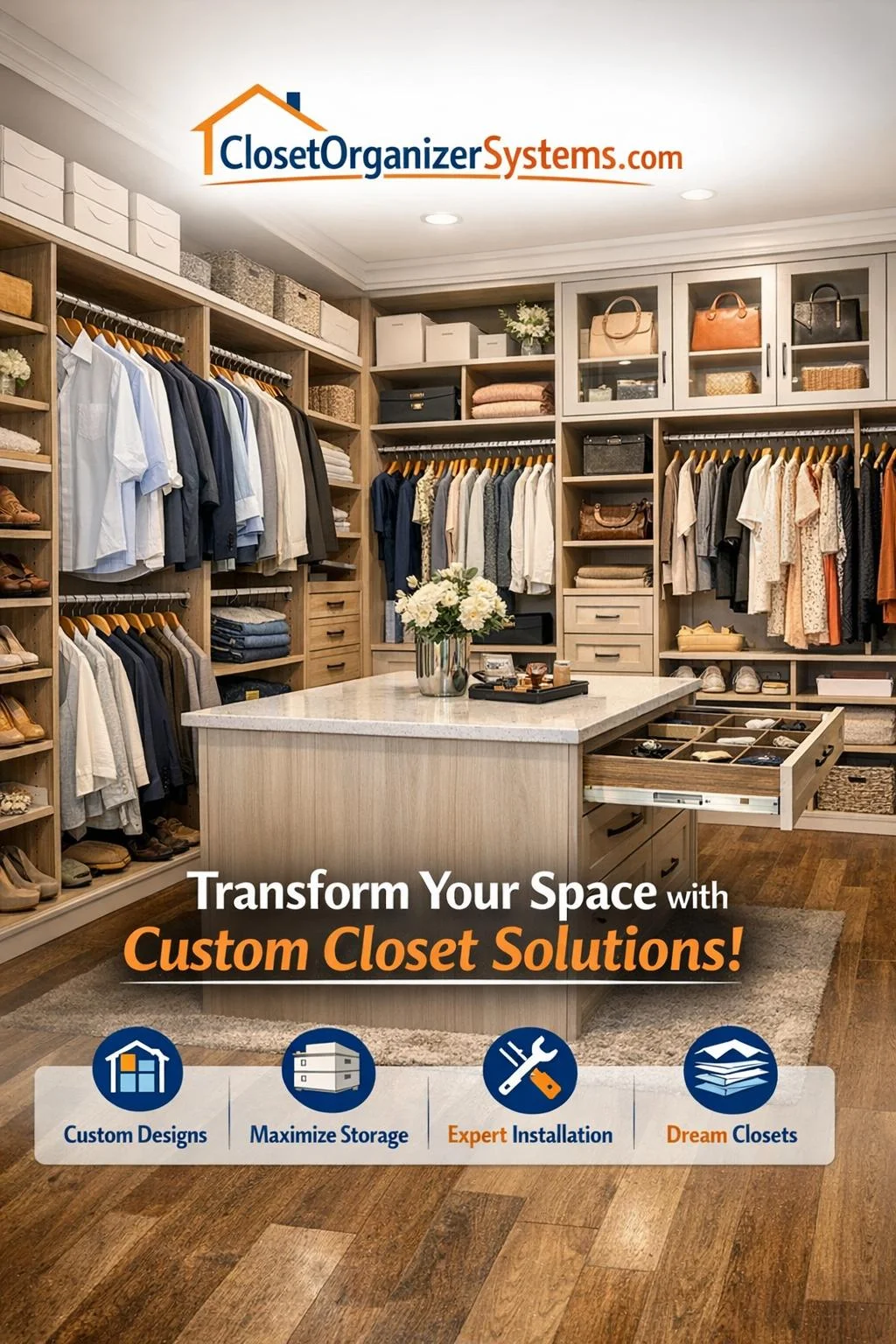
Types of Walk-In Closet Organization Systems
Walk-in closet organization systems fall into three primary categories: freestanding modular units, wall-mounted adjustable track systems, and fully custom built-in systems. Each has distinct advantages depending on budget, rental versus ownership status, and the degree of personalization required.
Freestanding Modular Systems
These are pre-manufactured units, typically sold as individual components that you combine to fit your space. They are the most accessible entry point for walk-in storage systems, and they perform reasonably well in standard-sized closets with rectangular layouts. The limitation is adaptability. Modular systems rarely account for ceiling height variations, angled walls, windows inside closet spaces, or non-standard room proportions.
Wall-Mounted Adjustable Track Systems
A significant step up in both performance and flexibility, wall-mounted systems attach directly to wall studs or use mounting rails that distribute load across the wall surface. The major advantage is adjustability, you can reconfigure shelf heights, add hanging rods, or reposition drawers as your wardrobe changes. For renters or homeowners who anticipate lifestyle changes, this is often the most practical walk-in storage system choice.
Custom Built-In Walk-In Closet Systems
Custom walk-in closets are designed and fabricated specifically for a given space and a given person. They account for every wall angle, architectural feature, and personal storage preference. The result is a system where nothing is wasted and everything has a designated place. Custom systems also offer the widest range of materials, from thermally fused laminate and melamine to solid hardwood, lacquered MDF, and glass-front cabinetry.
The cost difference between modular and custom is real, but so is the performance gap. We consistently observe that homeowners who invest in custom walk-in closet designs recover significant time and reduce wardrobe-related frustration in ways that modular solutions simply cannot match.
Walk-In Closet Layout Options and When to Use Each
The four standard walk-in closet layout configurations are single-wall, double-wall (parallel), L-shaped, and U-shaped. The best layout depends on room dimensions, door placement, and the ratio of hanging to folded storage the homeowner needs.
| Layout Type |
Best For |
Minimum Recommended Size |
Key Advantage |
| Single-Wall |
Narrow or converted spaces |
4 ft x 6 ft |
Simple, low-cost installation |
| Double-Wall (Parallel) |
Rectangular rooms with length |
5 ft x 8 ft |
Maximizes linear storage per square foot |
| L-Shaped |
Square rooms or corner spaces |
6 ft x 6 ft |
Natural zoning for different users or categories |
| U-Shaped |
Dedicated closet rooms |
7 ft x 10 ft |
Maximum storage capacity and organization depth |
Designing Small Walk-In Closets Without Compromising Function
Small walk-in closets are one of the most misunderstood design challenges in residential storage. The instinct is to cram in as much as possible. The correct approach is to be highly selective about what the space needs to accomplish and design precisely for that purpose.
For small walk-in closets under 50 square feet, we recommend the following principles:
- Prioritize vertical space: Shelving from floor to ceiling dramatically increases capacity without consuming floor area
- Use slimline drawer units: A 12-inch deep drawer tower along one wall can replace a full dresser elsewhere in the bedroom
- Install a center island only if the aisle remains 24 inches minimum on each side
- Choose pull-out features over open shelves for shoes and folded items: Pull-out trays and tilted shoe shelves improve access without requiring additional depth
- Use mirror surfaces strategically: A mirrored back wall or mirrored cabinet doors visually expands the space while serving a functional purpose
Small walk-in closets, when designed with intentional precision, often outperform larger closets that were designed without a clear organizational strategy.
The Real Difference Between Beautiful Walk-In Closets and Ones That Actually Work
Social media and home design publications have created a category of aspirational closet imagery that is frequently disconnected from real use. Beautiful walk-in closets typically feature open shelving lined with color-coordinated clothing, rows of identical hangers, and perfectly folded stacks. These images reflect a moment in time, not a system that sustains itself.
The closets that remain beautiful and functional six months after installation share specific structural characteristics:
- Closed storage for everyday items: Drawers and cabinet doors hide the natural chaos of daily use without requiring constant reorganization
- Generous drawer allocation: Most people significantly underestimate how many drawers they need in a walk-in organization system
- Dedicated zones for seasonal rotation: High shelving or pull-down rod systems accommodate seasonal wardrobe shifts without disrupting the primary organization
- Thoughtful accessory storage: Jewelry, belts, ties, scarves, and handbags need dedicated, accessible homes, not generic shelf space
- Adequate hanging rod length: Most wardrobes require more hanging space than homeowners initially estimate. We recommend a full inventory count before finalizing any custom walk-in closet design
“The most beautiful walk-in closets are not the ones with the least clutter. They are the ones where the system itself makes clutter naturally difficult to accumulate.”
Materials and Finishes for Custom Walk-In Closet Systems
The most common materials for custom walk-in closets are thermally fused laminate (TFL), melamine-coated particleboard, MDF with paint or lacquer finish, and solid or veneered hardwood. Each material offers a different balance of durability, aesthetic range, and cost. For most residential applications, high-quality TFL or painted MDF delivers excellent results at a practical price point.
Material Comparison for Walk-In Storage Systems
| Material |
Durability |
Aesthetic Range |
Relative Cost |
Best Application |
| Thermally Fused Laminate (TFL) |
High |
Wide, wood grain and solid colors |
Mid-range |
Most residential custom closets |
| Melamine Particleboard |
Moderate |
Limited, typically white or off-white |
Low to mid |
Budget-conscious builds |
| Painted MDF |
High (with proper primer) |
Unlimited color options |
Mid to high |
High-end custom finishes |
| Solid Hardwood |
Very High |
Natural grain, stain options |
Premium |
Luxury master closets |
| Veneered Plywood |
Very High |
Wide, wood aesthetics |
High |
Premium custom installations |
Hardware matters more than most homeowners realize. Soft-close drawer slides and door hinges, pull-out mechanisms rated for appropriate weight loads, and properly anchored hanging rods are the components that determine whether a walk-in closet system feels premium or cheap in daily use. We have seen beautiful custom casework undermined by inferior hardware, and vice versa, solid box construction elevated by exceptional hardware performance.
Walk-In Closet Lighting: The Most Overlooked Design Element
Poor lighting is the single most common unaddressed problem in walk-in closets, including expensive custom installations. A closet without adequate, even lighting forces you to make clothing decisions under uncertainty, which leads to garment mismatches, repeated organization failures, and general frustration with a space you spent real money building.
Best practice lighting for walk-in organization systems includes:
- Recessed overhead fixtures for general ambient light, ideally with a color rendering index (CRI) of 90 or higher to accurately represent clothing colors
- LED strip lighting under shelves and above hanging rods to eliminate shadows in the most-used zones
- Sensor-activated lights in deep drawers and lower cabinets
- A dedicated vanity light source near the mirror if the closet doubles as a dressing area
We recommend a color temperature between 2700K and 3000K for walk-in closets used as dressing rooms. This range approximates natural daylight without the harsh clinical quality of higher color temperatures.
Common Walk-In Closet Design Mistakes and How to Avoid Them
Having evaluated and redesigned many existing walk-in closets, we see the same mistakes repeated consistently. Understanding these is as valuable as knowing what to do correctly.
Mistake 1: Designing for Your Current Wardrobe Only
Wardrobes grow. A custom walk-in closet designed with zero flexibility or growth capacity will feel inadequate within a few years. Build in at least 15-20% excess capacity from day one, and choose systems with adjustable shelving wherever possible.
Mistake 2: Underestimating Shoe Storage Requirements
Shoes are consistently the most underplanned category in walk-in storage systems. A professional wardrobe audit typically reveals 30-50% more shoes than the homeowner initially estimates when planning. Count every pair before finalizing shoe storage sections.
Mistake 3: Ignoring the Center of the Room
An island with drawers or a center bench with built-in storage can transform the functionality of a walk-in closet with adequate square footage. Many homeowners leave this space empty or use it for hampers when it could be doing significant organizational work.
Mistake 4: Prioritizing Aesthetics Over Proportions
Tall, dramatic cabinetry looks impressive. But shelves positioned above 72 inches require a step stool for daily access, which means you will not use them for daily items and you will eventually stop using them altogether. Design the highest sections for genuine seasonal or archival storage only.
Mistake 5: Treating Hanging Sections as Uniform
Not all garments have the same hanging requirements. Full-length dresses and coats require 68 inches or more. Shirts, jackets, and folded pants work in a 42-inch double-hang configuration. A custom walk-in closet should allocate specific hanging lengths based on an actual inventory of the wardrobe, not generic assumptions.
Walk-In Closet Systems for Shared Spaces
When a walk-in closet serves two people, the design challenge is fundamentally different from a single-user space. The most successful shared walk-in closet systems we have designed use a clear bilateral zoning strategy: each person has a defined and fully contained zone, with shared infrastructure (lighting, a center island, a mirror) occupying neutral space between them.
Key principles for shared walk-in closets:
- Equal but not identical allocation: Each person’s zone should match their actual wardrobe profile, which is rarely perfectly equal
- Separate drawer towers: Shared drawers are a consistent source of organizational friction in couples’ closets
- Color or material differentiation: A subtle visual difference between zones, like a different cabinet door style or hardware finish, reduces confusion about ownership without requiring labels
- Individual accessory organization: Jewelry, watches, and accessories need dedicated, personally accessible storage for each user
How to Plan and Measure for a Custom Walk-In Closet
Planning a custom walk-in closet requires accurate room measurements including wall lengths, ceiling height, door swing radius, window and outlet locations, and any architectural irregularities like sloped ceilings or HVAC vents. A complete wardrobe inventory should be conducted simultaneously. The combination of room data and wardrobe data drives every layout and storage allocation decision in a well-designed closet system.
Step-by-Step Planning Process
- Measure all four walls at three heights: baseboard, mid-wall, and ceiling. Walls are rarely perfectly parallel, and discrepancies matter in custom installations
- Document all obstacles: doors, windows, electrical outlets, light switches, HVAC vents, and any structural protrusions
- Inventory your wardrobe by category: count hanging garments by length, folded items by stack, shoes by pair, and accessories by type
- Identify your daily-use items versus seasonal or archival storage and plan premium, easily accessible zones for daily-use categories
- Establish a priority hierarchy: if the space cannot accommodate everything optimally, what matters most to your routine?
- Review the layout in scale drawing form before finalizing any design or ordering any materials
Walk-In Closet Organization Systems: Pricing and Investment Context
Cost transparency matters in this industry, and we believe homeowners deserve realistic context rather than vague ranges. Walk-in storage system pricing varies significantly based on the type of system, materials, room size, and the complexity of the design.
| System Type |
Approximate Cost Range |
Includes |
| DIY Modular Systems |
$500 to $2,500 |
Materials only, self-installed |
| Wall-Mounted Adjustable Systems |
$1,500 to $5,000 |
Materials and professional installation |
| Semi-Custom Built-In Systems |
$3,000 to $8,000 |
Design, materials, professional installation |
| Fully Custom Walk-In Closet Systems |
$8,000 to $25,000+ |
Design consultation, fabrication, installation, hardware |
The variables that most significantly affect cost are material selection (laminate versus solid wood), hardware quality (standard versus soft-close and specialty pull-outs), room size, and design complexity. Lighting, flooring upgrades, and mirror integration are add-on costs that are frequently underbudgeted.
From a home value perspective, a well-executed custom walk-in closet is a recognized value-add in real estate. Master suite closets in particular are a consistent feature that home buyers identify as a meaningful purchase factor.
Trends Shaping Custom Walk-In Closet Design
The walk-in closet category has evolved significantly, driven both by changing lifestyle patterns and advances in cabinet hardware and storage accessories. Several trends are worth understanding if you are planning a new installation.
The Boutique Retail Aesthetic
Homeowners increasingly want their custom walk-in closets to feel like curated boutique retail environments, with open display sections for favorite pieces, integrated lighting, and a mix of open and closed storage that creates visual rhythm. This is achievable without sacrificing function, but it requires deliberate design rather than afterthought styling.
Integrated Vanity and Dressing Areas
Walk-in closets that incorporate a dedicated makeup or grooming station have grown in demand. This requires planning electrical access, appropriate lighting levels for personal care tasks, and counter surface space within the closet footprint.
Sustainable and Low-VOC Materials
Growing interest in indoor air quality has increased demand for CARB Phase 2 compliant panels, low-VOC finishes, and formaldehyde-free core materials in custom closet construction. This is especially relevant for enclosed spaces like walk-in closets with limited ventilation.
Smart Storage Accessories
Pull-down hanging rods for high installations, motorized accessories, and sensor-activated lighting systems are transitioning from luxury novelties to practical tools in high-end walk-in closet systems.
Neutral, Timeless Finishes
Highly trendy finishes have a short shelf life in closets that are built to last. We observe sustained preference for warm whites, soft greiges, and natural wood-tone laminates that remain current across design cycles rather than dating the space.
Myths vs. Facts: Walk-In Closet Organization Systems
Myth: Bigger Is Always Better
Fact: A large walk-in closet with poor design underperforms a compact, well-designed one. Organization quality is determined by design precision, not square footage.
Myth: Open Shelving Keeps You More Organized
Fact: Open shelving creates a pressure to maintain visual perfection that most people cannot sustain. A balanced mix of open and closed storage produces systems that stay organized with normal daily use.
Myth: Custom Walk-In Closets Are Only for Large Homes
Fact: Some of the most impactful custom walk-in closet systems are installed in modest homes where bedroom space is limited and storage efficiency is critical. Custom design scales down just as effectively as it scales up.
Myth: You Can Plan a Custom Closet Without a Wardrobe Inventory
Fact: Designing a closet without knowing what goes in it is one of the most reliable ways to produce a beautiful but functionally inadequate result. A thorough wardrobe inventory is the non-negotiable first step in any professional closet design process.